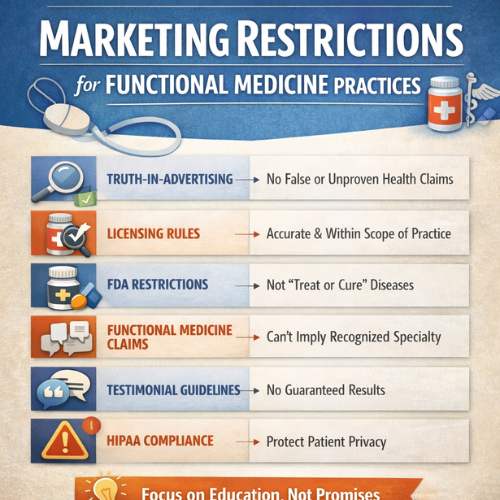
Marketing a functional medicine practice is not like marketing a restaurant or a software company. There are real rules — enforced by the FTC, the FDA, state medical boards, and advertising platforms — that govern what you can and cannot say.
Most practitioners know there are restrictions. Very few know exactly where the lines are. The result? Either they say too much and expose themselves to liability, or they say too little and their marketing fails to connect with patients.
This guide breaks down the key restrictions you need to know — and shows you how to stay compliant while still writing marketing that actually works.
Why Healthcare Marketing Is Different
Standard marketing is allowed to be persuasive, even aspirational. Healthcare marketing carries a higher burden because the stakes are higher — people make real medical decisions based on what they read.
The core principle across all regulations is this: you cannot make claims that are false, misleading, or that you cannot substantiate. That sounds simple, but in practice it requires a clear understanding of where the boundaries are.
The Four Main Areas of Restriction
1. Truth-in-Advertising Rules (FTC)
The Federal Trade Commission requires that all advertising — including your website, social media, and paid ads — must be truthful, non-deceptive, and backed by evidence.
This applies directly to claims like:
- Results ("Our patients lose 20 lbs in 30 days")
- Testimonials ("Read how Sarah reversed her diabetes")
- Comparisons ("Better than conventional medicine")
The Rule: If you use patient testimonials, you must include a clear disclaimer that results are not typical. You also cannot cherry-pick outlier results and present them as the norm.
2. FDA Restrictions on Health Claims
The FDA draws a firm line between what licensed healthcare providers can say and what constitutes an illegal drug or device claim.
Specifically, you cannot claim that a treatment, supplement, or protocol will:
- "Treat, cure, or prevent" any named disease (e.g. "We treat Hashimoto's" or "Cure your leaky gut")
- Diagnose a medical condition not within your licensed scope
- Replace prescribed medications without appropriate clinical context
What you CAN say instead:
"We work with patients who have been diagnosed with thyroid conditions to support optimal function."
"Our approach addresses root causes that may contribute to digestive discomfort."
Structure-function language ("supports," "may help," "contributes to") is permissible. Disease treatment language is not.
3. Licensing and Scope of Practice
Every state has its own medical board regulations, and functional medicine practitioners often operate across a spectrum of licensed disciplines — MDs, NDs, DOs, health coaches, nutritionists.
Your marketing must accurately reflect your credentials and the scope of what your licence allows you to offer. Specifically:
- Do not use the title "Doctor" in marketing if your licence does not permit it in your state.
- Do not imply you provide services beyond your scope (e.g. a nutritionist implying they diagnose medical conditions).
- If you offer telehealth, be aware that some states require you to disclose the patient's state of residence and your licensure in that state.
4. Platform-Specific Rules (Meta, Google)
On top of legal regulations, advertising platforms have their own policies — and they are often stricter.
Meta (Facebook & Instagram):
- Prohibits ads that imply knowledge of a user's health condition ("Are you struggling with fatigue?" can be flagged)
- Restricts before-and-after imagery for health services
- Requires disclaimers on weight-loss or health transformation claims
Google Ads:
- Healthcare and medicine is a "sensitive category" requiring certification for some ad types
- Personalised advertising based on health data is restricted
- Remarketing to health audiences requires compliance with Google's healthcare advertising policies
Pro Tip: Both platforms can disapprove ads or suspend accounts without much warning. Always keep compliant ad copy as a backup and avoid language that personalises health struggles directly to the reader.
What You CAN Market — and How to Do It Effectively
Compliance does not mean boring or ineffective marketing. It means shifting from disease-claim language to outcome and experience language.
Instead of: "We cure thyroid disease."
Say: "We help patients with thyroid concerns finally understand what's driving their symptoms — and build a plan to address it."
Instead of: "Reverse your diabetes naturally."
Say: "We work with patients to improve metabolic health through root-cause testing and personalised protocols."
Instead of: "Our supplements treat leaky gut."
Say: "Our gut health protocols are designed to support the integrity of the digestive lining."
This language is accurate, credible, and — critically — it speaks directly to how your ideal patients think and search. Patients researching functional medicine are already sceptical of miracle cure claims. Honest, outcome-focused language builds more trust, not less.
A Practical Compliance Checklist for Your Marketing
✅ Review your website for "treat, cure, prevent" language and replace with structure-function language.
✅ Add a disclaimer to all patient testimonials: "Results may vary."
✅ Ensure your credentials and scope of practice are accurately represented.
✅ Review your ad copy against Meta and Google's healthcare advertising policies before launching campaigns.
✅ If you use before-and-after content, include appropriate disclaimers.
✅ Have a healthcare-experienced copywriter or lawyer review your core marketing pages annually.
The practices that win at healthcare marketing are not the ones who push every boundary — they are the ones who communicate clearly, build trust systematically, and let their clinical results do the talking. Compliance is not the obstacle to great marketing. It's the foundation of it.